


Navigating the Rapids: Contrasting Indigenous Health in New Brunswick and Ontario
- gilliangillies0
- Mar 17, 2024
- 7 min read
Updated: Mar 18, 2024

In the vast landscape of Canada's healthcare challenges, the disparities faced by Indigenous communities are troubling and complex. My classmate Marlee and I focused our attention on comparing two distinct provinces—New Brunswick and Ontario. The contrasts in access to clean water, prevalence of chronic diseases, and overall health outcomes become apparent. Exploring these differences offers a deeper understanding of the comprehensive issues at play and highlights the urgent need for meaningful solutions and change. We navigated the intricacies of Indigenous health disparities, shedding light on the realities faced by Indigenous communities across these regions of New Brunswick and Ontario. The Indigenous communities have faced historical challenges, including issues related to land rights, cultural preservation, and socio-economic disparities in both provinces.
Population Demographics
First, regarding the population demographics (on and off-reserve populations), we found differences right away. There is a greater population of Indigenous persons living on-reserve in New Brunswick, whereas the opposite was found to be true in Ontario. Ontario is covered by 46 treaties, which were signed between 1781 and 1930. New Brunswick has 15 Indigenous communities.
The two links below capture a map of Indigenous communities, categorized by province.
Map of Ontario's First Nation and Treaties: iao-first-nations-and-treaties-map-en-2022-10-31.pdf (ontario.ca)
Map of New Brunswick's First Nations Communities: first-premieres-nations-nb.pdf (gnb.ca)

Indigenous Health
Regarding primary health care access for Indigenous individuals, New Brunswick demonstrates inferior performance relative to Ontario. Indigenous peoples experience specific challenges related to the accessibility of health services across all geographic regions; however, the challenges are more acute in rural, remote, and northern communities.
The proportion of First Nations people and Métis reporting waiting for more than 2 weeks to see their health care provider in 2017-2020 was higher in the Atlantic provinces (19.7% (First Nations); 20.9%(Métis)), compared to Ontario (12.9% (First Nations); 13.6% (Métis)) and more generally to other regions. It is heartbreaking that many had waiting times this long for immediate care needs (Statistics Canada, 2023).
Primary health care is just one basic health need. Many communities didn’t even have clean water. I should note this isn’t just a basic health need; it’s a human necessity. Ontario and New Brunswick were both identified among the 250 Indigenous communities that experienced long-term water advisories, some lasting over a year (First Nations Drinking Water Settlement (n.d.)).
First Nations have a unique, complex relationship with water that extends beyond using water for their personal or community needs or as the life-support system for the foods they harvest and consume (Government of Canada, 2021). First Nations’ relationship with water includes cultural, spiritual, economic, stewardship, governance, and rights-based aspects. For Indigenous people, water is more than just hydration: It's alive and holds a spirit. Water is life (Government of New Brunswick, 2018).
In recent years, the number of communities with unsafe drinking water has dropped, but the long-running problem has remained a source of embarrassment across all of Canada. Both the province of New Brunswick and Ontario were affected by this basic need. In New Brunswick, communities affected include Tobique, Woodstock, Oromocto, Bouctouche, Indian Island, Eel Ground, Pabineau, and Fort Folly First Nations. New Brunswick has finally taken a proactive approach with their 10-year Water Strategy action plan (2018-2028), incorporating an indigenous perspective as it relates to water (Government of New Brunswick, 2018).
Specifically in Ontario 1 in 5 First Nations household relies on a private well for drinking water, and 57 percent of households rely on a household septic system. The cost to monitor quality and maintain the safety of these systems can be difficult to afford. A primary contributor to this inertia is the legal discrimination that exists related to the regulation and protection of drinking water for First Nations reserves (Humans Right Watch, 2016). With absence of regulation, the concern persists, not just in Ontario or New Brunswick but all across Canada. As part of an improvement initiative, the provincial Government of Ontario announced in 2021 that they were partnering with the federal government to provide $15 million in funding for on-reserve water projects, which includes $2.7 million in provincial funds allocated for drinking water projects in 91 First Nations communities in Ontario. The government also stated that they are committed to collaborating with First Nations communities to resolve long-term drinking water advisories and ensure the development of a long-term strategy to address these needs(Government of Ontario, 2021). I am optimistic that these initiatives will yield positive outcomes, emphasizing the crucial need for their sustainability.
Fluoride is a naturally occurring mineral present in nearly all water sources. It is naturally released from rocks into the soil, water, and air. Drinking water that contains fluoride has long been associated with reduced tooth decay (Government of Canada, 2022). Indigenous communities face disparities in accessing fluoridated water, with New Brunswick exhibiting particularly pronounced deficiencies overall in comparison to Ontario, however displays a slighter greater percentage compared to Ontario Indigenous Communities.
Fluoridated Water Accessibility | 2022 | 2022 |
Total Population Non-Indigenous Communities | Total Population Indigenous Communities | |
Ontario | 74.7% | 1.3% |
New Brunswick | 9.4% | 3.8% |
Government of Canada (2022)
Regarding chronic disease and illness, the rates are higher in New Brunswick compared to Indigenous populations in Ontario. For example, when looking at diabetes, rates in New Brunswick are 5.5 times higher in First Nations people off reserve than in the non-Indigenous population, a situation compounded by barriers to care for Indigenous peoples (Diabetes Canada, 2022). There are 29,380 Indigenous peoples in New Brunswick, who face significantly higher rates of adverse health consequences than the overall population (Diabetes Canada, 2022). When dissecting Ontario, the prevalence of diabetes among First Nations adults living off reserve, Métis adults, and Inuit adults is 1.72 times, 1.22 times, and 1.18 times higher respectively than the prevalence among non-Indigenous adults (Diabetes Canada, 2023). In addition to the risk factors that impact all people in Canada, the ongoing burden of colonization continues to influence the health of Indigenous peoples.
The below graph captures other chronic disease comparisons between New Brunswick and Ontario for Indigenous and non-Indigenous communities.

Health indicator profile. Statistics Canada. (2016, December 9).
Chronic disease can also be linked to various risk factors such as environmental influences, genetics, and behaviors like smoking and alcohol consumption. The New Brunswick Health Council Survey highlighted differences in alcohol consumption and susceptibility to smoking among public school students across the province in 2018-2019. The data for alcohol consumption, smoking, and cannabis use are higher in Indigenous students. The tables below highlight the differences in the survey, specifically in New Brunswick.
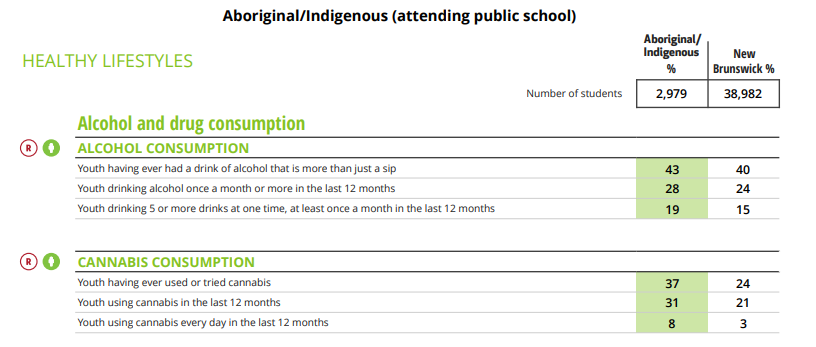

New Brunswick Health Council Student Wellness Survey (2020)
Similarities were also identified in Ontario's public schools, highlighting differences in alcohol consumption, cannabis use, and susceptibility to smoking between Indigenous and non-Indigenous students. Sikorski (2019) found that Indigenous youth had higher odds of smoking (odds ratio of 5.26) and drinking (odds ratio of 1.43) than non-Indigenous youth. Additionally, more Indigenous youth than non-Indigenous youth had higher odds of past-year marijuana use. Notably, Indigenous youth, particularly males, tended to drink alcohol and use marijuana at younger ages (Sikorski, 2019).
A broader comparison in the graph below highlights risk factors by % comparison. The statistics includes all population age groups by province (Ontario and New Brunswick).

(Statistics Canada, 2016)
*Regarding the risk factor term "Alcohol", this includes 5 or more drinks on one occasion, at least once a month in the past year
**Regarding the risk factor term "Fruit and Vegetable consumption", this makes reference to 5 times or more per day
Conclusion
In examining the healthcare disparities among Indigenous communities in New Brunswick and Ontario, it's evident that the trends arise and inequalities are apparent. From access to clean water to chronic disease prevalence, the realities faced by Indigenous peoples demand immediate attention and action. Both provinces exhibit unique complexities in healthcare access and outcomes, reflecting broader systemic issues rooted in historical marginalization and colonization. I feel we must do better and strive for equitable healthcare, and ensure Indigenous perspectives and data to address these longstanding injustices. I am grateful to have paired up with my classmate from Ontario, Marlee, this week who brought excellent insight and was also able to clearly articulate the ongoing and longstanding inequalities.
Resources
Diabetes Canada (2022, February). Diabetes in New Brunswick 2022 Backgrounder. Retrieved March 16, 2024, from https://diabetes.ca/DiabetesCanadaWebsite/media/Advocacy-and-Policy/Backgrounder/2022_Backgrounder_New-Brunswick_English_1.pdf
Diabetes Canada (2023, July 23). Diabetes in Ontario 2023 Backgrounder. Retrieved March 16, 2024, from https://www.diabetes.ca/DiabetesCanadaWebsite/media/Advocacy-and-Policy/Backgrounder/2023_Backgrounder_Ontario.pdf
First Nations Drinking Water Settlement (n.d.). First Nations Drinking Water. Retrieved March 16, 2024, from https://firstnationsdrinkingwater.ca/index.php/documents/
Government of Canada. (2022, December 20). The State of Community Water Fluoridation across Canada. https://www.canada.ca/en/public-health/services/publications/healthy-living/community-water-fluoridation-across-canada.html
Government of New Brunswick (2018). A Water Strategy for New Brunswick 2018-2028. Environment and Government. Retrieved March 16, 2024, from https://www2.gnb.ca/content/dam/gnb/Departments/env/pdf/Water-Eau/WaterStrategy-StrategieSurLeau/WaterStrategy-2018-2028.pdf
Government of New Brunswick (n.d.). Indigenous Affairs. First Nations Communities. Retrieved March 9, 2024, from https://www2.gnb.ca/content/gnb/en/departments/aboriginal_affairs/fnc.html
Government of Ontario (2022, October 31). Ontario First Nations Maps. Ontario First Nations Maps. Retrieved March 16, 2024, from https://www.ontario.ca/page/ontario-first-nations-maps
Government of Ontario (2021, June 24). Working with First Nations to improve drinking water. Government of Ontario Environment and Energy. Retrieved March 18, 2024, from https://www.ontario.ca/page/working-first-nations-improve-drinking-water
Human Rights Watch (2016, June 7). Make it Safe: Canada’s Obligation to End the First Nations Water Crisis. Retrieved March 16, 2024, from https://www.hrw.org/report/2016/06/07/make-it-safe/canadas-obligation-end-first-nations-water-crisis
New Brunswick Health Council (2020, January 1). New Brunswick Student Wellness Survey 2018-2019 (Results for Aboriginal Persons). Retrieved March 16, 2024, from https://nbhc.ca/sites/default/files/publications-attachments/SWS18-19-Results%20for%20Aboriginal%20-%20Indigenous%20Students.pdf
Satistics Canada (2021, July 6). Government of Canada progress update on improving access to clean water in First Nations communities. Government of Canada. Retrieved March 16, 2024, from https://www.canada.ca/en/indigenous-services-canada/news/2021/07/government-of-canada-progress-update-on-improving-access-to-clean-water-in-first-nations-communities.html
Statistics Canada. (2016, December 9). Health indicator profile, by Aboriginal identity and sex, age-standardized rate, four year estimates. https://www150.statcan.gc.ca/t1/tbl1/en/cv.action?pid=1310009901
Satistics Canada (2023, October 6). Primary health care access among First Nations people living off reserve, Métis and Inuit, 2017 to 2020. Statistics Canada. Retrieved March 16, 2024, from https://www150.statcan.gc.ca/n1/pub/41-20-0002/412000022023005-eng.htm
Sikorski, C., Leatherdale, S., & Cooke, M. (2019). Tobacco, alcohol and marijuana use among Indigenous youth attending off-reserve schools in Canada: cross-sectional results from the Canadian Student Tobacco, Alcohol and Drugs Survey. Consommation de tabac, d’alcool et de cannabis chez les jeunes autochtones qui fréquentent des écoles hors réserve au Canada : résultats transversaux de l’Enquête canadienne sur le tabac, l’alcool et les drogues chez les élèves. Health promotion and chronic disease prevention in Canada : research, policy and practice, 39(6-7), 207–215. https://doi.org/10.24095/hpcdp.39.6/7.01


Comments